
If you need to see small things clearly, you have more than one option. Alongside the magnifying lamp there are magnifying glasses, head-worn magnifiers and the classic hand lens. They differ less in magnification than in what they demand of your body — and in whether they bring their own light.
The magnifying lamp
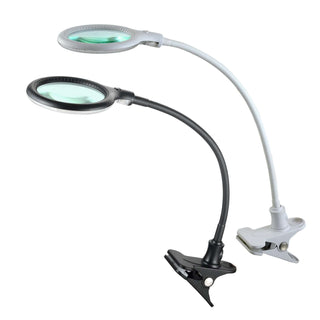
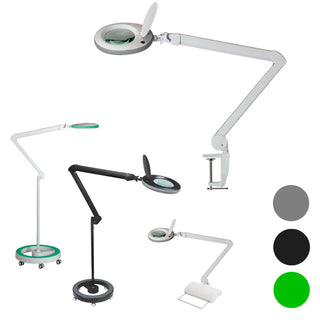
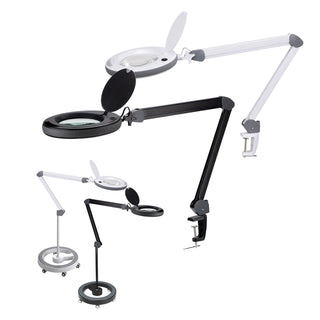
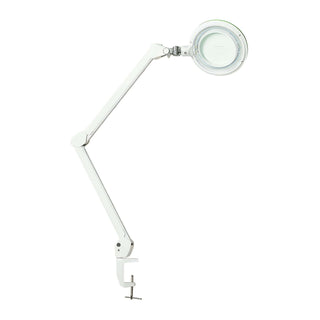
Lens and lighting sit in one device, and the device hangs on an arm or stands on the desk. Both hands stay free, your head stays upright, and the lighting is the same at every step. That is the real point: what tires you over hours is not the magnification but changing light and a bent posture.
Its limit is location. A magnifying lamp belongs to a workstation. If you move around the room, or work on the object rather than at the desk, it serves you poorly.
Magnifying glasses
Light, discreet, on and off in a second: magnifying glasses travel with your gaze and take no space at all. For short checks, for work away from a desk and anywhere without a fixed workstation, they are hard to beat.
Two things are worth knowing. First, they almost never bring light of their own — the illumination has to come from elsewhere, and that is exactly where much fine work fails. Second, the magnifications are modest, and the working distance pulls your head close to the piece. After an hour you feel it in your neck.
The head-worn magnifier
A head magnifier goes further: higher magnifications, often with interchangeable lenses, usually with a small LED. Both hands are free and the optics follow your head — a genuine advantage when the workpiece does not lie flat on a table, for instance during repairs on a device.
In return, you wear it. Weight on the forehead, pressure from the band, a warm head and a battery that eventually runs out. The built-in light is by nature small and does not replace workplace lighting. For long sessions in one place it is rarely the first choice.
The hand lens
It remains unbeatable for a quick look — at small print, an engraving, a serial number. The moment both hands are needed, it is out.
The length of the job decides
A workable rule of thumb: up to about ten minutes at a stretch, a hand lens or magnifying glasses will do. Between ten minutes and an hour at the piece, a head magnifier earns its place if you have to move freely. Anything that regularly runs longer and happens at a table belongs under a magnifying lamp — because of the even light and the upright posture, not because of the optics.
And the designs do not exclude one another. Many workshops have both: the magnifying lamp at the bench and a head magnifier for the walk over to the machine.
A note on reading glasses
If you wear reading glasses, keep them on under the magnifying lamp. The two effects do not simply add up, but your glasses correct your eyes while the lens magnifies the work — they complement each other. More on that, and on choosing the right strength, in dioptres and magnification. Which design suits your desk is covered in standing magnifier or magnifying lamp on an arm.

0 comments