
One lamp, many hands
In a training workshop, school laboratory or apprentice room, different rules apply than at a private hobby table. The lamp is not set up by one person and then left alone for years — it is adjusted daily, operated by changing people and rarely treated gently. That shifts the selection criteria.
What really matters here
Robust mechanics rather than maximum reach
The articulated arm is the component that suffers first in training use. Pulling the lamp by the arm instead of the head loads the joints sideways. One sentence during induction prevents that — it belongs there just as much as the instruction not to hang anything on the arm. What the mechanics can take and what they cannot is in the article on the articulated arm.
Fixed mounting rather than a rolling stand
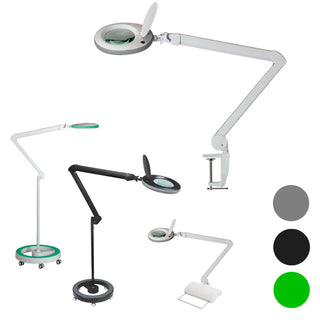
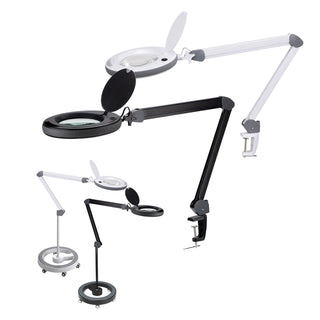
A rolling stand is practical when one person moves it. In a room with fifteen apprentices it is a trip hazard and it wanders. At fixed workbenches the table clamp is the better choice — it costs no working surface and stays where it belongs. The desktop may be no more than 65 mm thick for that; with the solid benches in training workshops it is worth measuring. All options in the article on mounting.
The weaker lens is the better one
The most common mistake when equipping for the first time: buying too strong. An 8-dioptre lens leaves only around 9 cm of working distance — too little to work under with a soldering iron, and too tight for someone doing it for the first time. 3 or 5 dioptres are almost always the right choice for training purposes. Only for pure visual inspection of solder joints does 8 make sense, and then better as a single device for the inspection station.
Think of spare parts
What breaks in a training workshop breaks repeatedly: table clamps and lenses. Both are available individually. One or two clamps in the cupboard save the loss of a workstation in the middle of a course — more in the article on spare part supply.
Where classroom use pays off
- Electronics and mechatronics — reading component markings, judging solder joints, tracing conductor paths
- Biology and science — as an intermediate step between the naked eye and the microscope, with the advantage that several people can look at the same object at once
- Craft training — fits, surfaces, material faults
- Support teaching and visual aid — for pupils with impaired vision, an aid that does not stand out
Before the bulk order
A sample costs little and answers the questions no datasheet can: does the clamp fit our benches? Does the arm reach across the workbench? Do the apprentices get on with the strength? For schools, chambers and training providers we issue quotations on account — the process is in the article for business and tenders.

0 comments